The Appreciation Cycle: Understanding Commercial Real Estate Timing in Infrastructure-Driven Markets
The National Capital Region stands at an inflection point. Two massive infrastructure projects—the Noida International Airport at Jewar and a series of expressway corridors connecting it to Delhi and beyond—are converging to fundamentally alter where and how commercial real estate develops across the NCR. Unlike previous cycles driven purely by speculation, this transformation is driven by operational reality: the airport is now live, and the highway network, while still under construction, is proceeding on a documented timeline.
This is not a story about one project or one sector. It is a story about how infrastructure creates economic geography. As the airport begins operations and expressway connectivity improves, entire swaths of commercial real estate that were once considered peripheral are becoming prime locations. Simultaneously, traditional commercial hubs face new competition for tenants and capital.
Understanding this shift requires looking beyond the headlines and examining what is actually happening on the ground across multiple commercial corridors and asset classes.
THE INFRASTRUCTURE REALITY: APRIL 2026
Noida International Airport – Operational
The Noida International Airport at Jewar was officially inaugurated on March 28, 2026. This is not a future prospect or a construction milestone. The airport is now handling commercial flights, with operations expected to ramp up through mid-2026 and beyond. The facility includes a fully operational 3,900-meter runway, a 100,000 square meter terminal for domestic and international passengers, cargo handling infrastructure, and ground support systems. While the airport is currently accessible primarily via existing roads—the Yamuna Expressway, Noida-Greater Noida Expressway, and local network—the operational status is certain.
The presence of a functioning international airport changes the calculus for commercial real estate immediately. Businesses no longer need to speculate about whether the airport will open; they need to decide whether their current location still makes sense given the new reality of accessible air connectivity in the Noida region.
Highway Corridor – Under Construction, Timeline Clear
The promised expressway connectivity to the airport is progressing, though on a slower timeline than original announcements suggested. The Jewar-Faridabad Expressway, a 31-kilometer 6-lane corridor, is under construction with a targeted completion date of April 2027. This project, worth approximately 3,630 crore rupees, will provide direct high-speed connectivity from South Delhi, Faridabad, and Gurugram to Jewar Airport.
Additionally, plans are advancing for expansion of the Yamuna Pushta Road into a 30-31 kilometer elevated 10-lane corridor, providing an alternative Delhi-to-airport route along the Yamuna embankment. The Delhi-Mumbai Expressway, of which portions are already operational, is expected to be fully connected to the airport network by December 2026.
The significance of April 2027 as a timeline cannot be overstated. This is when direct high-speed access to the airport from major commercial centers becomes available. This single infrastructure completion will alter travel times from 45-60 minutes to 20-25 minutes, reshaping commute-shed economics for commercial real estate across the entire NCR.
THE IMMEDIATE IMPACT: AIRPORT OPERATIONAL, HIGHWAYS STILL BUILDING
The Congestion Reality
With the airport now operational but direct expressway connectivity still under construction, traffic patterns have shifted in ways that were not always anticipated. The existing Noida-Greater Noida Expressway, which was designed to handle regional traffic flows, is now also the primary airport access corridor. This has created congestion in Sector 140A and surrounding commercial areas during peak hours, with journey times to the airport extending to 45-60 minutes from South Delhi or Gurugram.
This congestion is creating immediate pain for some businesses but also immediate opportunity for others. Companies that have urgent need to be near the airport are willing to accept premium rental rates for locations that offer expedited access, even if the access is currently congested. Meanwhile, logistics operators, warehouse facilities, and hospitality providers are rapidly establishing themselves along the current airport approach routes, anticipating that April 2027 will bring dramatically increased traffic volumes.
The Staging Zone Phenomenon
A notable pattern is emerging in commercial real estate along the Noida-Greater Noida Expressway corridor, particularly in Sector 140A and adjacent areas. Businesses are treating these locations as “staging zones”—positions they can occupy for 12-18 months until the Jewar-Faridabad Expressway opens, at which point they may relocate to more optimal positions closer to the airport or in newly accessible areas.
This has created a distinct rental market. Occupancy rates for commercial spaces along the current airport approach corridor have risen from approximately 75-80 percent in early 2026 to 80-85 percent currently, with rental growth of 8-12 percent year-on-year. Landlords are capitalizing on this by offering shorter lease terms (2-3 years) rather than traditional 5-year agreements, recognizing that tenants want flexibility until the new highway network stabilizes and longer-term location decisions become clear.
The Airport Spillover Effect
Beyond the direct staging zone phenomenon, the opening of Noida International Airport has begun generating economic activity in adjacent areas. The Noida International Film City, located along the Yamuna Expressway near Greater Noida, has moved from planning stage to operational status, with active film production underway. This signals that infrastructure readiness is attracting not just theoretical investment but actual business operations.
The film city development has already begun attracting hospitality, food and beverage, and ancillary commercial services to the surrounding area. Hotels are being planned or upgraded in Greater Noida and Noida to serve the airport, film city, and expanded commercial activity in the corridor. This is driving commercial real estate development beyond just office space into mixed-use development, food courts, and service-oriented retail.
THE SECTOR 140A COMMERCIAL CORRIDOR: GROUND REALITY
Sector 140A has emerged as the focal point of this infrastructure transition, though not always in the ways originally anticipated. The sector sits at the intersection of multiple transportation networks: the Noida-Greater Noida Expressway (current airport approach), the Yamuna Expressway (alternate access from the south), and the future Jewar-Faridabad Expressway (planned direct connectivity).
The commercial landscape in Sector 140A is mixed. There are existing IT and ITES operations in the area, established over the past five years as companies looked for cost advantages relative to Gurugram. New commercial projects have been launched, with developers betting on airport proximity. However, the market is more cautious than the 2024-2025 period suggested it would be. Major corporate relocations have not yet occurred. Speculative development has slowed. Companies are waiting for the April 2027 highway opening before making definitive location decisions.
Currently, Sector 140A commercial real estate is experiencing steady but not explosive growth. Property values have risen, but at rates consistent with general NCR commercial appreciation (8-12 percent annually) rather than airport-driven premiums. Rents are rising, but occupancy rates, while improving, remain below the 90 percent levels that would typically be expected in a high-growth corridor immediately adjacent to a newly operational airport.
This measured pace reflects rational business decision-making. The airport is operational, but the infrastructure that would make Sector 140A a genuinely convenient location remains incomplete. Businesses can access the airport from Sector 140A, but the 45-60 minute journey time means location decisions are not yet optimized.
BROADER SECTOR IMPACT: COMPETITIVE DYNAMICS
Gurugram’s Position Under Pressure
The Jewar Airport and expressway developments are creating competitive pressure for Gurugram’s long-established commercial real estate market. Gurugram has traditionally dominated NCR office space, with premium infrastructure, established commercial clusters, and high-quality buildings commanding top-tier rental rates. However, Gurugram’s advantages are increasingly geographic disadvantages.
From Gurugram, the journey to Noida International Airport requires crossing through Delhi or taking circuitous routes via the Eastern Peripheral Expressway. Once the Jewar-Faridabad Expressway is operational, companies in Gurugram that require frequent airport access will face 40-50 minute journeys compared to 20-25 minutes from Sector 140A or Greater Noida locations. This creates a natural migration pressure.
Several mid-market IT and BPO companies that have historically expanded into Gurugram are now considering alternatives. Landlords in Gurugram are beginning to offer rental discounts to retain tenants, particularly those with regular airport interactions. This is a subtle but significant shift in the commercial real estate dynamics of the NCR.
Greater Noida and Extended Noida Regions
Paradoxically, Greater Noida and areas along the Yamuna Expressway are experiencing increased commercial interest, not just from businesses relocating from within Noida but from companies considering alternatives to Gurugram. The airport access is more direct from these areas than from Gurugram, and rental costs are significantly lower. The Noida International Film City development is attracting service sector investment that previously would have gravitated to Gurugram or Central Delhi.
The commercial real estate market in Greater Noida, which was considered a secondary market for much of the past decade, is now positioning itself as a cost-effective alternative to Gurugram with superior airport connectivity. Several logistics and warehousing developments are underway along the Yamuna Expressway specifically to serve airport-dependent businesses.
South Delhi and Faridabad: New Gateway Status
The Jewar-Faridabad Expressway is creating unexpected winners in South Delhi and Faridabad commercial real estate. Faridabad, long considered peripheral to the main NCR commercial corridor, is becoming a gateway to the airport via the Faridabad-Jewar expressway. Companies in South Delhi are reconsidering their footprint, as airport access will improve dramatically once the expressway opens.
Several commercial developers in South Delhi and Faridabad are launching new projects or repositioning existing ones specifically around the airport connectivity narrative. This is opening commercial real estate opportunities in areas that were previously considered low-priority by multinational or large Indian corporate tenants.
THE TIMELINE COMPRESSION: APRIL 2027 AS THE INFLECTION POINT
What Changes When the Expressway Opens
The April 2027 opening of the Jewar-Faridabad Expressway will create a market inflection point. Travel times from key commercial centers to the airport will be cut approximately in half. This seemingly technical achievement will have immediate and significant commercial real estate consequences.
First, location decisions that were on hold will be made decisively. Companies currently occupying “staging zone” positions in various sectors will either commit to longer-term occupation or relocate. This will create a wave of lease renewals and relocations.
Second, new commercial clusters will crystallize. Areas that are currently experiencing steady growth will enter high-growth phases. Sector 140A, currently appreciating at 8-12 percent annually, will likely see acceleration to 15-25 percent appreciation in the 12-month period surrounding the highway opening. Rental rates will increase correspondingly as tenants compete for available space in optimally positioned locations.
Third, commercial projects that have been in slower-motion development will accelerate. The Fairfox EON complex in Sector 140A, which has been progressing steadily, will enter a phase of accelerated occupancy and potentially accelerated expansion. Other commercial developments across the Sector 140A corridor and in Greater Noida will see demand surge.
The 12-Month Window: April 2026 to April 2027
The period from April 2026 (current time) to April 2027 represents a unique window for commercial real estate investors and operators. The airport is operational, creating real demand drivers. The highway is under construction, with clear timeline and progress tracking. Market pricing has not yet fully incorporated airport operational status or highway certainty.
Investors who acquire commercial property during this window—before the April 2027 highway opening fully reprices the market—will capture appreciation from two sources: the initial airport operational premium and the subsequent highway completion premium. Investors who wait until after April 2027 will face already-repriced valuations and will likely capture only the longer-term structural appreciation, not the near-term cyclical gains.
For occupiers (businesses leasing rather than buying), the timing dynamic is different but similarly important. Securing multi-year leases in well-positioned commercial spaces before April 2027, at rates that have not yet incorporated the full airport-highway benefit, provides locked-in costs as the market appreciates around them.
COMMERCIAL REAL ESTATE CATEGORIES: DIFFERENTIAL IMPACT
Office Space and IT-ITES Clusters
The office and IT-ITES sector is experiencing the most direct impact from the airport and highway infrastructure. Tier-1 IT companies with existing Gurugram operations are evaluating whether maintaining or expanding in Gurugram makes sense given the airport access differential. Tier-2 and mid-market IT and BPO companies are increasingly considering Sector 140A, Greater Noida, and extended Noida corridors as viable alternatives to Gurugram, offering both cost advantages and superior airport connectivity once the expressway opens.
Several commercial office developments in the Sector 140A corridor have reported increased lease inquiries from IT companies that had previously not considered the area as a primary market. Pre-leasing rates for new office developments have improved from the typical 30-40 percent to 50-60 percent for properties well-positioned on airport approach corridors.
Logistics, Warehousing, and Industrial Real Estate
This category is seeing perhaps the most dramatic impact. The airport requires supporting logistics infrastructure: ground handling facilities, cargo consolidation centers, warehousing for just-in-time manufacturing, and distribution facilities for import-dependent businesses.
Several large warehouse and logistics developments are underway or planned in Greater Noida and the Noida-Greater Noida corridor specifically to serve airport-dependent supply chains. YEIDA (the development authority governing the corridor) has allocated industrial plots to electronics manufacturers, aerospace players, logistics firms, EV companies, and apparel units, with explicit objective of creating clustering around airport logistics infrastructure.
The rental market for logistics and warehousing in these areas is appreciating faster than office space, with some warehouse facilities seeing rental growth of 12-18 percent year-on-year as demand from airport-dependent businesses accelerates.
Retail, Hospitality, and Mixed-Use Development
The airport and surrounding corridor are generating demand for hospitality, food and beverage, and retail services. Hotels are being planned or upgraded in areas adjacent to the airport approach corridors. Food courts and quick-service restaurant clusters are being developed to serve airport traffic and airport-adjacent workers. Retail developments are being planned both as standalone facilities and as components of larger mixed-use developments.
The Noida International Film City development is particularly notable in this regard, as it is generating demand for hospitality and food service facilities that extends beyond just airport-related travel. This demonstrates that the corridor is developing multiple economic drivers, not just airport-dependent activity.
Coworking and Managed Office Space
An emerging category is coworking and managed office space, which is expanding rapidly across the Noida and Greater Noida regions. Companies operating in these spaces appreciate the flexibility to occupy smaller footprints with shorter lease terms, which aligns with the “staging zone” phenomenon described earlier. Several major coworking operators are expanding their presence in Sector 140A and Greater Noida specifically in anticipation of increased demand once airport connectivity improves.
THE APPRECIATION TIMELINE: UNDERSTANDING THE CYCLE
Current Phase: Airport Live, Highway Under Construction (April 2026 – April 2027)
During this period, commercial real estate in airport-proximate areas is experiencing steady appreciation driven by operational airport demand. Growth rates of 8-12 percent annually are typical for office space and 12-18 percent for logistics-focused real estate. Rental rates are rising as occupancy improves. However, the market has not yet fully incorporated the certainty of April 2027 highway completion or the dramatic improvement in connectivity it will bring.
This is the period when valuations are most attractive relative to future cash flows. The appreciation is real—driven by actual airport demand—but the valuation is not yet inflated by anticipation of the next inflection point.
Transition Phase: Highway Opens, Market Reprices (April 2027 – Q3 2027)
When the Jewar-Faridabad Expressway opens, the market will rapidly reprice airport-proximate commercial real estate. Travel times will improve, and businesses will shift location decisions from “should we be near the airport?” to “where specifically should we be positioned for optimal airport access?”
During this period, appreciation can accelerate to 20-30 percent as the market reprices properties based on new connectivity reality. Rental rates will increase correspondingly. Occupancy rates for well-positioned properties will rise toward 95 percent as demand outpaces supply during the transition.
This repricing will be most dramatic for properties in Sector 140A and the immediate Noida corridor, which will benefit most directly from the expressway opening. Properties in areas further from the airport or in less convenient locations will see more modest repricing.
Stabilization Phase: New Market Equilibrium (Q4 2027 – 2028+)
After the initial repricing phase, the market will stabilize into a new equilibrium. Appreciation rates will moderate back toward 12-15 percent annually, reflecting the structural advantage of airport proximity rather than the temporary dynamic of connectivity improvement.
Rental rates will stabilize at new levels, reflecting true airport-driven demand. Occupancy rates will settle at levels representing market equilibrium—typically 85-90 percent for office space and 80-85 percent for mixed-use or secondary commercial uses.
This stabilization is when longer-term investment decisions should be made by businesses and investors seeking sustained returns rather than cyclical capital gains.
RISK FACTORS AND UNCERTAINTIES
Construction Delays
Indian infrastructure projects routinely experience delays. The April 2027 completion date for the Jewar-Faridabad Expressway is optimistic. A realistic assessment would include 6-12 month buffer for delays. If the expressway completion slips to Q2 or Q3 2027, the commercial real estate appreciation cycle will similarly shift, with implications for investment timing and lease decision-making.
Macro-Economic Headwinds
If India experiences broader economic slowdown or if the NCR specifically faces economic challenges, airport growth and commercial real estate demand could decelerate even with improved connectivity. The fundamentals of airport proximity would remain strong, but the near-term appreciation trajectory would be less dramatic.
Occupier Demand Assumptions
The thesis assumes that businesses will prioritize airport proximity sufficiently to relocate or reposition significantly. If occupier preferences shift (for example, if remote work becomes more prevalent than currently anticipated, or if supply chain patterns evolve differently than expected), the demand drivers could be weaker than projected.
Metro and Rapid Rail Timing
Public transportation connections to the airport (planned metro and rapid rail projects) are currently scheduled for 2028-2031 timelines. These projects could accelerate or decelerate the residential spillover and broader economic development around the airport. Delays would slow down secondary effects but would not fundamentally alter the primary infrastructure impact.
BROADER IMPLICATIONS FOR NCR COMMERCIAL REAL ESTATE
The End of Gurugram Dominance
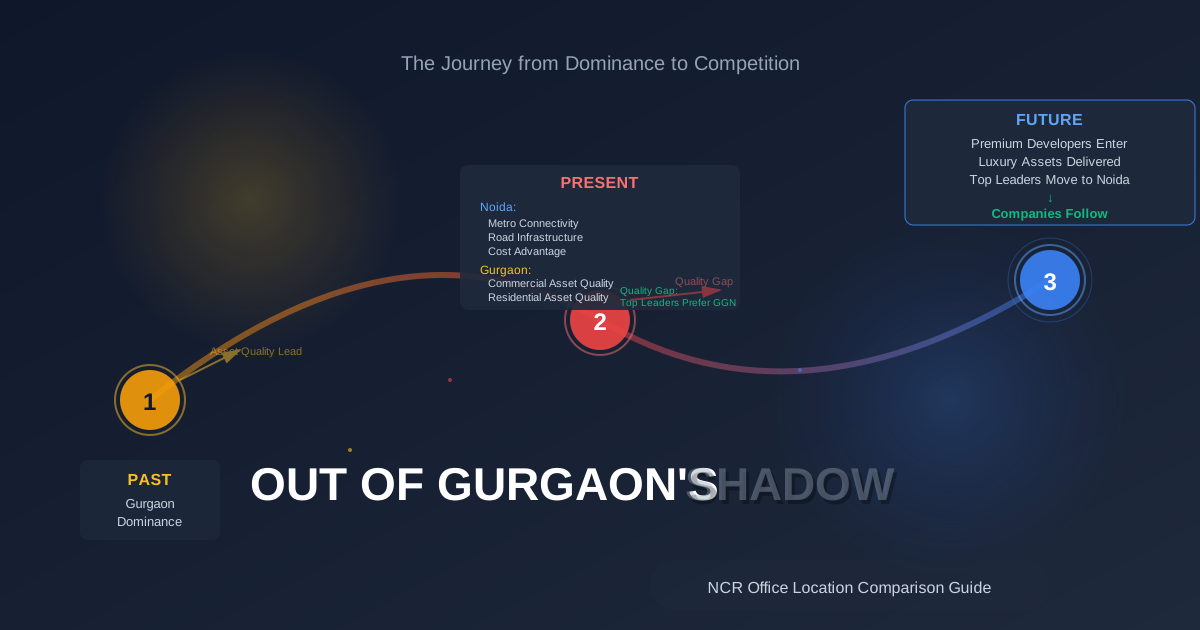
The Jewar Airport and expressway developments represent a structural shift in NCR commercial real estate geography. Gurugram’s dominance as the primary commercial destination for multinational corporations and large Indian companies is being challenged by cost and connectivity advantages in Noida, Greater Noida, and the extended corridor.
This does not mean Gurugram will decline. Gurugram has established agglomeration economies, quality infrastructure, and institutional depth that will sustain significant commercial real estate demand. However, its competitive position is weakening, and the pace of new commercial development may slow as both companies and capital explore alternatives.
The Rise of Corridor-Based Development
Rather than concentrating all commercial development in a single hub (as Gurugram has been), the Jewar Airport infrastructure is fostering distributed development along multiple corridors: the Noida-Greater Noida Expressway, the Yamuna Expressway, the Faridabad-Jewar Expressway, and others. This corridor-based development model may prove more sustainable and efficient than the traditional hub-based model.
Infrastructure as Primary Real Estate Driver
The Jewar Airport and expressway projects demonstrate that infrastructure connectivity is the primary driver of commercial real estate value and growth. Regions with superior connectivity to economic anchors (like the airport) consistently outperform regardless of other factors. This insight should shape commercial real estate decision-making going forward, with infrastructure timelines and certainty being paramount considerations.
CONCLUSION: THE APRIL 2027 INFLECTION POINT
The convergence of Noida International Airport operational status and expressway corridor development is reshaping commercial real estate across the NCR. The period from April 2026 to April 2027 represents a unique window when the airport is driving real demand but the full connectivity benefits have not yet been realized and priced into the market.
Investors who position themselves during this window, whether acquiring property for appreciation or securing long-term leases at pre-inflection rates, will benefit from the April 2027 expressway opening and the commercial real estate repricing that will follow. Those who move after April 2027 will face an already-repriced market and will capture only the longer-term structural appreciation rather than the near-term cyclical gains.
For occupiers, the timing is similarly critical. Securing well-positioned commercial space before the market reprices, whether in Sector 140A, Greater Noida, South Delhi, or other airport-proximate locations, provides locked-in cost advantages as surrounding real estate values appreciate.
The infrastructure story is real. The timeline is clear. The opportunity window is open. The question for investors and occupiers is whether they will act during the present moment of opportunity or wait until the market has already repriced the value of infrastructure transformation.