Terminal Velocity — How IGI Airport’s Commercial District Became Delhi-NCR’s Most Occupied Coworking Market
The Aerocity Effect
How a single planned precinct became Delhi’s coworking capital — and how it transformed from a 6-operator boutique market to India’s most ambitious aviation-adjacent flex district in 18 months
at Aerocity (Q2 2026)
(6.7× current stock)
by 2028 (3 buildings)
flights commenced
A Planned District That Changed Delhi’s Office Map
Delhi Aerocity — formally the Hospitality District of Indira Gandhi International Airport — is an approximately 220-acre mixed-use development built by GMR Group adjacent to IGI Airport’s Terminal 3. It is the first truly Grade-A commercial precinct in Delhi proper: planned from scratch, served by dedicated metro infrastructure (Aerocity Metro Station, Airport Express Line), and designed to international office standards with large contiguous floor plates, 24×7 utilities, and a curated retail and hospitality mix.
This is a critical distinction from the rest of Delhi’s commercial stock. Connaught Place evolved from colonial-era administrative buildings. Nehru Place grew from 1980s IT market development. Okhla and Saket came from industrial-to-commercial conversions. Aerocity was designed as an office district — which means it has the physical infrastructure that enterprise coworking operators require: floor plates of 20,000–60,000 sq ft per floor, district cooling, multiple basement parking levels, and ground-floor retail that creates a full-day destination experience for occupiers and their clients.
The Buildings That Matter
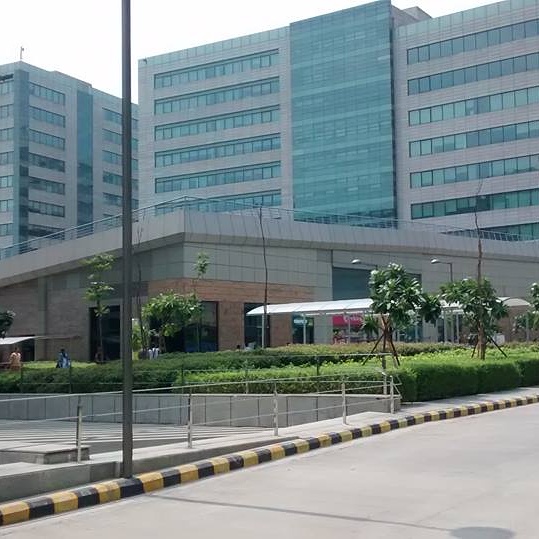
Aerocity’s coworking activity is anchored in the Worldmark complex — Worldmark 1, 2, and 3 developed by Bharti Realty, and the newer Worldmark 4, 5, 6, and 8 now under construction or recently completed. These towers offer total leasable area exceeding 2.5 million sq ft across the original three buildings, with Worldmark 4 through 8 adding substantially more. The concentration in Worldmark means that virtually every significant coworking operator at Aerocity — CoWrks, Table Space, WeWork India, Avanta, and the upcoming The Executive Centre — has primary presence in this one complex. The Caddie Commercial Tower hosts Regus. Pride Plaza Hotel (Asset 5A, managed by Pride Hotels) hosts Innov8. The Aloft Hotel campus hosts Synq.Work. And the Roseate House (Bharat Hotels) operates its own boutique workspace “Upstage Club” within its hotel property.
The result is that Aerocity coworking is effectively two sub-markets: the large-format enterprise-grade centres in the Worldmark towers (CoWrks, Table Space, WeWork India, TEC, Avanta), and the hotel-integrated workspace offerings in the hospitality properties (Roseate House Upstage, Synq.Work at Aloft, Innov8 at Pride Plaza) that blend desk-access with hotel amenities.
A Market That Transformed in 18 Months
As recently as early 2025, Aerocity had approximately 1,900 tracked seats across six operators — a premium but boutique market. By Q2 2026, three major entries (WeWork India, Table Space, and the announced Executive Centre) have fundamentally changed the scale and competitive intensity of the market. This section documents the full current roster with sourced data for every claim.
The Worldmark Anchor Operators
Detailed Operator Profiles
| Operator | Building | Seats | Area (sqft) | Product Type | Notes |
|---|---|---|---|---|---|
| Table Space Oct 2025 | Worldmark 4 (Level 3) | 3,000+ | 50,000+ | Managed office (Suites) | Debut Delhi entry; enterprise-only ‘Suites’ product; targets MNCs and GCCs; fully managed, branded office environments |
| The Executive Centre Pipeline | Worldmark 4 (Level 7), 6, and 8 | 5,000+ | 4,80,000 | Premium serviced / flex | Phase 1: WM4 L7 – 1,01,000 sqft / 1,100 seats; Phase 2: WM6 – 1,12,000 sqft / 1,220 seats; Phase 3: WM8 – 2,67,000 sqft / 2,800 seats. Announced Apr 2026, phased delivery through 2028. |
| WeWork India 2025 | Worldmark 6 (Level 3) | 1,400 | 1,10,000 | Coworking + managed office | 17th Delhi-NCR WeWork location; listed BSE/NSE Oct 2025; flexible and dedicated desk products alongside private suites for enterprise teams |
| CoWrks | Worldmark 1 (Tower A) | 786 | 55,012 | Coworking + private suites | RMZ Corp-backed; flagship Delhi centre since 2018–19; full-floor presence; zero listed availability on aggregators (near full occupancy); meeting suites, cafeteria, event space |
| CoWrks Atelier | Worldmark 3 | 355 | 62,453 | Executive suites | 24 private suites (7–33 seats each); CoWrks’ ultra-premium product tier; separate branding from main CoWrks product; two levels |
| Avanta Business Centre | Worldmark 2 | Not listed | N/A | Serviced office | Long-standing business centre operator; coworking desks, serviced offices, virtual office products; well-reviewed for professional service quality |
| Innov8 | Pride Plaza Hotel (Asset 5A) | 220 | N/A | Community coworking | OYO-backed; vibrant community product in hotel setting; dedicated desks, private cabins 2–6 seater; 700m from Aerocity Metro; ₹22,999/month |
| Regus | Caddie Commercial Tower | Not listed | N/A | Serviced office (IWG) | Legacy IWG Group brand; private offices and dedicated desks; standard Regus product; ₹27,390/month; Mon–Sat |
| Synq.Work | Aloft Hotel campus | Not listed | N/A | Hotel-integrated workspace | Sophisticated business-travel-focused setup; meeting rooms, business centre; blend of hotel amenity and workspace; ₹18,000/month |
| Roseate House “Upstage Club” Hotel | Roseate House Hotel (Bharat Hotels) | ~100 desks | ~30,000 | Hotel-integrated boutique | 5-star hotel-operated workspace; flexible hot desks, private pods, 2 meeting rooms, boardroom, 6 meeting pods; open Mon–Sat 9AM–6PM; ₹39,000/month — Aerocity’s most premium per-seat price. The highest desk rate in the cluster. |
Why Aerocity Commands a Persistent Occupancy Premium
Even with the dramatic inventory expansion of 2025–2026, the original operators at Aerocity — CoWrks Worldmark 1, CoWrks Atelier, and Innov8 — continue to run at or near full occupancy. Understanding why illuminates the structural demand drivers that make Aerocity unique in Delhi’s coworking landscape.
Four Structural Reasons Aerocity Sustains Premium Occupancy
1. GCC and Aviation-Linked Demand Concentration
Aerocity is the preferred address for GCCs that need a Delhi NCR base without Gurgaon’s long commutes for South Delhi employees. Airlines (IndiGo, Air India, SpiceJet ground operations), aviation services companies, FMCG brands requiring IGI-proximate offices, and financial services firms with frequent international travel needs all cluster here. These tenants require managed private suites — the highest-value, lowest-churn product — and they have little interest in hot-desking or open coworking alternatives.
2. Supply Discipline by Developer
Unlike Delhi’s other commercial corridors where any building owner can convert to coworking, Aerocity’s supply is controlled by two developers — GMR Group and Bharti Realty — who maintain lease quality standards that filter out marginal operators. Until 2025, this supply discipline created a deliberately limited market: when CoWrks filled up, there was no immediate alternative within the precinct. The 2025–2026 new operator wave (Table Space, WeWork India, TEC) represents a controlled release of pent-up demand, not a breakdown of quality standards.
3. Premium Pricing Self-Selects Tenants
At ₹18,000–39,000 per seat per month — compared to ₹8,000–18,000 in most other Delhi corridors — Aerocity self-selects for well-funded companies that value the address for client-facing or regulatory reasons. These tenants have longer commitment horizons, larger space requirements, and lower churn — characteristics that translate directly into sustained high occupancy for operators willing to underwrite large lease commitments.
4. Unmatched Metro + Airport Connectivity
The Airport Express Line’s Aerocity station provides direct, high-frequency connectivity to New Delhi Railway Station (~14 min) and IGI Airport Terminal 3 (~4 min) — the only metro line in India connecting a major railway terminus directly to an international airport. No other Delhi micro-market combines Grade-A office stock with airport-direct metro access. For corporate tenants with heavy international travel or client-facing requirements, this connectivity premium is quantifiable and durable. It does not diminish over time the way a “new building” advantage might.
From Hospitality District to Flex Capital: 2010–2026
Aerocity vs Delhi’s Other Coworking Corridors
The contrast between Aerocity and Delhi’s other major coworking corridors illuminates what makes a coworking cluster work versus what creates over-supply and occupancy pressure.
| Corridor | Operators | Approx Seats | Avail Seats | Occupancy Signal | Key Characteristic |
|---|---|---|---|---|---|
| Aerocity | 9+ | 6,000+ (Q2 2026) | Low for legacy ops | Premium / ~88% legacy | Planned Grade-A; GCC + aviation tenants; 3 major new entries 2025–26; TEC pipeline |
| Nehru Place | 14 | ~2,042 | ~751 | ~63% | Tech heritage corridor; fragmented older buildings; national + local brands |
| Dwarka | 14 | ~1,636 | ~612 | ~63% | Residential catchment; SME + freelancer demand; newer development |
| Saket | 17 | ~2,662 | ~1,307 | ~51% | Retail + office mixed; boutique community operators; Select City Walk halo |
| Connaught Place | 15 | ~2,606 | ~1,694 | ~35% | Heritage CBD; prestige address but poor building quality; over-supplied |
| Okhla | 7 | ~1,596 | ~876 | ~45% | Industrial-to-office conversion; D2C and e-commerce tenants; emerging |
The Connaught Place Paradox
Connaught Place is Delhi’s most prestigious commercial address — the historic heart of the capital — yet it has the lowest coworking occupancy of any major Delhi corridor at just 35%. This paradox resolves when you understand the building stock: CP’s inventory consists largely of colonial-era structures with low floor-to-ceiling heights, inefficient layouts, limited parking, and aging electrical infrastructure. These buildings attract operators on the strength of the address but cannot deliver the space quality that corporate tenants increasingly require. The result is an over-supplied corridor where 15 operators compete for a tenant base that would rather pay a premium for newer space elsewhere — a cautionary tale for any operator prioritising address over building quality.
What Okhla Could Become
Okhla at ~45% occupancy has the most interesting medium-term trajectory of Delhi’s secondary corridors. Its combination of relatively modern industrial buildings (many converted 2015–2020), proximity to a growing D2C and e-commerce tenant cluster, and access to South Delhi’s talent pool creates a structural demand story not yet reflected in its occupancy. The challenge is narrative and identity: Okhla lacks the corporate prestige to attract GCC-quality clients who choose office address partly for employee recruitment signalling. But for operators focused on the creative economy, tech startups, and D2C brands, Okhla’s economics are compelling — lower rents, newer buildings, a tenant profile that values community over corporate address.
The $2.5 Billion Expansion: What 10 Million Sq Ft Means for Flex
The single most consequential medium-term development for Aerocity’s coworking market is not the new operators that have already entered — it is the scale of GMR and Bharti Realty’s planned expansion. Aerocity’s current ~1.5 million sq ft of leasable commercial space is set to increase to over 10 million sq ft by 2029, a 6.7× expansion representing approximately $2.5 billion of investment. Worldmark 4, 5, and 6 are under construction or recently completed. Worldmark 8 is in the pipeline. India’s largest planned mall has been approved for the precinct. The question for coworking operators is whether demand can scale commensurately with supply.
across Worldmark 1–3 + others
total leasable area
across WM 4, 6, 8
India’s largest planned mall
The Bull Case: Supply Unlocks Pent-Up Demand
Aerocity’s primary constraint until mid-2025 was not demand — it was supply. CoWrks WM1 showed zero available inventory because it was full, not because no new tenants wanted Aerocity. The precinct was turning away demand it could not accommodate. Table Space’s 3,000-seat entry and WeWork’s 1,400-seat entry both represent demand that was previously diverted to Gurgaon or Noida simply because Aerocity had nothing to offer them. In this scenario, the 10 msf target absorbs pent-up demand from GCCs and enterprise occupiers who have long wanted the Aerocity address but could not find inventory. TEC’s 5,000-seat commitment — announced before any buildings are delivered — is the strongest possible indicator that institutional demand exists for new Aerocity supply at scale.
The Bear Case: Aerocity Overshoots
The 10 msf target may overshoot the available corporate demand for an airport-adjacent Delhi address. GCCs expanding in NCR have historically preferred Gurgaon’s Cyber City and Golf Course Road for talent reasons — Aerocity’s airport adjacency is a premium for companies with heavy international travel requirements, a defined but finite segment. If 10 msf of new supply arrives faster than this demand pool absorbs it, Aerocity’s occupancy premium could compress toward the 60–70% range that characterises mid-market Delhi corridors. For flex operators, this is not necessarily negative in the short term — more space means more entry opportunities — but it removes the supply-scarcity dynamic that historically drove pricing power at CoWrks and Roseate House.
Operator Implications: The Three New Entry Winners
The 2025–2026 Aerocity expansion has produced clear winners among the operators who moved early. Table Space has secured first-mover advantage at Worldmark 4 with the largest single coworking deployment in Aerocity’s history — 3,000+ seats in the ‘Suites’ managed office product targeted directly at the GCC demand segment that defines Aerocity’s tenant base. WeWork India’s Worldmark 6 centre establishes its first Aerocity presence after years of being unable to find suitable space in the precinct, adding credibility to its listed operator status and its enterprise managed office offering. The Executive Centre’s 4.8 lakh sq ft commitment represents the most confident long-term bet on Aerocity’s premium demand thesis — a global operator staking a substantial portion of its India strategy on this single cluster.
The Replication Thesis: Three Candidates, One New Frontrunner
The Aerocity template — planned Grade-A development + aviation/institutional demand anchor + developer supply discipline = sustained premium occupancy — is widely understood in India’s real estate community. Two 2025–2026 developments have materially updated the replication picture: the Aerocity 2.0 expansion (proving institutional developers are doubling down on the model) and the opening of Jewar Airport (creating the physical conditions for the first genuine Aerocity-equivalent on NCR’s eastern corridor).
The Three Necessary Conditions
Three conditions consistently appear necessary for an Aerocity-style premium coworking cluster to emerge. First, a developer with the capital and institutional discipline to build Grade-A commercial space at scale — 30,000+ sq ft per floor, district cooling, 24×7 utilities — rather than incremental conversions of older stock. Second, a demand anchor that generates consistent, high-quality corporate footfall: T3 airport for Aerocity, IT parks for Noida’s Sector 62, financial services clusters for Gurgaon’s Cyber City. Third, controlled supply discipline enforced by the landlord — the ability to maintain lease quality standards and filter out marginal operators. Without all three simultaneously, the economics default to over-supply and average occupancy.
Candidate 1: The Jewar Airport Corridor (Yamuna Expressway) — New Frontrunner
The opening of Noida International Airport at Jewar on March 28, 2026 — with commercial flights beginning June 15, 2026 — has created the most compelling Aerocity replication opportunity in India. The Yamuna Expressway belt between Greater Noida and Jewar now has what Aerocity had in 2010: a brand-new airport, land available for institutional-quality development, and the infrastructure investment (Yamuna Expressway, planned metro extension, RRTS connectivity proposals) that makes large-scale commercial development viable.
Several factors distinguish Jewar from previous replication attempts. The airport is new and purpose-built (not retrofitting around an old facility). The Yamuna Expressway Authority controls significant land parcels adjacent to the airport and can enforce development quality standards in the manner GMR enforces them at Aerocity. The existing Greater Noida tech corridor provides an established talent pool within 20–30 km. And hotel groups (IHG, Marriott, Radisson) and commercial developers have been pre-positioning since 2022 in anticipation of the airport opening — compressing the infrastructure timeline relative to what Aerocity experienced. The timeline for a meaningful coworking cluster at Jewar, if developers execute on announced plans, is 3–5 years (2028–2031) — not the decade it took at Aerocity.
Candidate 2: Dwarka Expressway (Northwest Gurgaon / West Delhi Border)
The Dwarka Expressway corridor — with Grade-A commercial development by DLF (Downtown), BPTP, and M3M now substantially built out — has made real progress. New metro connectivity and RRTS corridor planning have begun to activate corporate demand. However, Dwarka Expressway remains constrained by the absence of a single institutional demand anchor comparable to T3 or Sector 62’s tech cluster. Its tenant base is primarily residential-spillover corporate demand — companies following their employee population rather than companies drawn by a specific operational node. This produces decent occupancy in the 60–70% range but not the 88% premium that an anchor-driven market achieves.
Candidate 3: Rohini – Netaji Subhash Place
NSP has the most underserved demand base in Delhi but the smallest probability of becoming a genuine Aerocity equivalent. North and West Delhi’s corporate demand — real estate, trading, FMCG distribution, educational services, healthcare administration — is served almost entirely by Grade-B buildings in NSP and Rohini. A developer willing to build institutional-quality commercial space here would face limited direct competition and a genuinely captive tenant base. The constraint is identity: NSP does not have the brand to attract GCC-quality occupiers who choose office address partly for employee recruitment signalling, and until it does, it will remain a mid-market corridor. The path to change requires a single high-profile anchor tenant — perhaps a government agency, a PSU headquarters, or an MNC making a deliberate “North Delhi” statement.