Delhi Aerocity’s Transformative Expansion: Future Outlook
The future of Aerocity is poised for unprecedented growth, with transformative developments that will reshape Delhi’s commercial landscape. The most significant development on the horizon is the planned construction of India’s largest mall, spanning over 2.8 million square feet, scheduled for completion in 2027. This landmark retail development represents just one facet of an ambitious $2.5 billion expansion plan that will fundamentally transform the region.
The scale of expansion is remarkable: from its current footprint of 1.5 million square feet of leasable space, most of it is office space in Aerocity, Aerocity is projected to grow more than sixfold to exceed 10 million square feet by 2029. This massive expansion will create India’s first fully realized aerotropolis, setting new benchmarks for airport-centric urban development in the country.
Aerocity 2029: The Future Aerotropolis
India’s Largest Mall
Expansion Investment
Total Leasable Space by 2029
2024-2026: Foundation
- Groundwork for massive expansion
- Mall construction begins
- Infrastructure development
- Increased speculative demand
2027-2028: Evolution
- Mega mall completion
- Retail integration
- Entertainment hub development
- Commercial space surge
2029+: Full Realization
- Complete aerotropolis
- International HQ hub
- Specialized business clusters
- Advanced transportation links
From Business District to Urban Center
Transforming into India’s first fully-realized aerotropolis, setting new benchmarks for airport-centric development
Short-term Transformation (2024-2026)
The immediate future will see the groundwork being laid for this massive expansion. Construction activity will intensify as developers begin work on the landmark mall project and associated infrastructure. This period will likely see increased speculative demand in the commercial real estate market as investors and businesses position themselves to capitalize on the upcoming developments.
Medium-term Evolution (2027-2028)
The opening of India’s largest mall in 2027 will mark a pivotal moment in Aerocity’s evolution from a business district to a comprehensive urban center. This period will witness the integration of retail, entertainment, and commercial spaces at an unprecedented scale. The mall’s completion will likely trigger a surge in demand for surrounding commercial spaces as businesses seek to benefit from increased foot traffic and enhanced amenities.


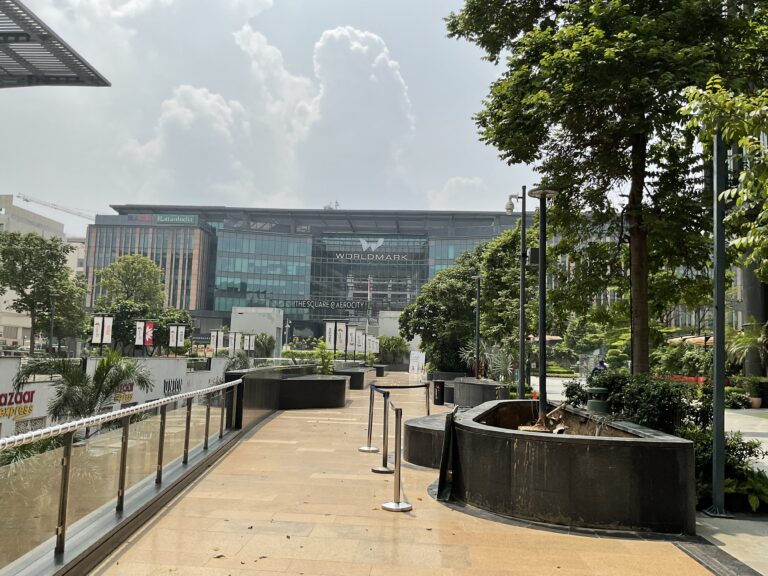
World mark 4,5,6 along with Prestige Trade tower currently underworks at Aerocity, Slated to be ready for business by mid of 2025 and later this year.
Long-term Vision (2029 and Beyond)
By 2029, with its projected expansion to over 17 million square feet of leasable space, Aerocity will emerge as one of India’s most significant commercial hubs, especially for organizations looking for quality office space in Delhi. This expansion will likely incorporate:
The development will transcend traditional office space to create an integrated urban ecosystem where commercial, retail, and leisure spaces coexist seamlessly. The increased scale will likely attract a more diverse tenant mix, including international corporations seeking to establish regional headquarters.
The expanded Aerocity will serve as a prototype for future aerotropolis developments across India, demonstrating how airport-adjacent developments can evolve into comprehensive urban centers. The integration of advanced transportation infrastructure, including potential connections to the upcoming Jewar Airport, will further enhance its position as a strategic business location.
Market Implications
This unprecedented growth trajectory will have far-reaching implications for Delhi’s commercial real estate market. The substantial increase in leasable space will likely introduce new grade-A office inventory at a scale previously unseen in the region. This expansion could potentially reshape rental dynamics across Delhi-NCR, with Aerocity establishing new benchmarks for premium commercial space.
The development will likely catalyze the emergence of specialized business clusters, particularly in sectors requiring high connectivity such as consulting, technology, and international trade. The increased scale of operations will enable Aerocity to accommodate larger corporate campuses and specialized facilities that were previously unfeasible due to space constraints.
Investment Landscape
The massive expansion plans signal strong confidence in Aerocity’s future, likely attracting increased institutional investment. Real Estate Investment Trusts (REITs) and international investors will likely view this growth as an opportunity to participate in India’s evolving commercial real estate market. The development’s scale and strategic importance could potentially lead to the creation of dedicated investment vehicles focused on aerotropolis developments.
This transformative expansion will establish Aerocity not just as Delhi’s premier commercial district, but as a model for airport-centric urban development across emerging markets. The development’s evolution from a business district to a comprehensive urban center represents a new paradigm in commercial real estate development, one that combines strategic location, scale, and integrated urban planning to create sustainable value for businesses and investors alike.