Office Space in West Delhi: Evolution and Growth
West Delhi’s commercial real estate landscape represents a unique evolution from industrial corridors to diverse business districts. The region’s development pattern differs significantly from South and Central Delhi, characterized by its transformation from manufacturing hubs to modern commercial zones, while still maintaining its industrial heritage in certain pockets.
The geographical expanse of West Delhi’s commercial belt encompasses a diverse range of locations including Moti Nagar, Rama Road, Shivaji Marg, Naraina Industrial Area, Mayapuri Industrial Area, Rajouri Garden, Paschim Vihar, Janakpuri, Uttam Nagar, Vikaspuri, Punjabi Bagh, and Dwarka. This vast territory stretches from Punjabi Bagh in the north to Dwarka in the south, bounded by industrial corridors and rapidly developing urban extensions. Each of these submarkets has developed its own distinct character, from industrial conversions to planned commercial centers, creating a varied commercial landscape with diverse development trajectories and market dynamics.
Historical Evolution and District Development
The 1960s marked the beginning of West Delhi’s organized commercial development, initially centered around industrial estates. Naraina Industrial Area, established in the early 1960s, became one of Delhi’s first planned industrial estates. The area initially housed manufacturing units but gradually evolved to accommodate service industries and later, commercial offices. This transition set a pattern that would be repeated across West Delhi’s commercial landscape.
Moti Nagar’s development in the 1960s and early 1970s was anchored by major industrial establishments like DCM and Birla. The area’s commercial character emerged gradually, as industrial plots were repurposed for commercial use and new office buildings were developed along main arterial roads. The DCM complex, once a manufacturing facility, has transformed into a mixed-use development incorporating office spaces.
The 1970s and 1980s saw the emergence of two major District Centers in West Delhi – Janakpuri and Rajouri Garden. The Janakpuri District Centre emerged as a significant commercial hub, though its building stock now shows considerable age. Key buildings in this district include Mahatta Tower, Sagar Tower, Vishal Tower, Jyoti Shikhar, Suneja Tower, and Vishwadeep Tower. While these buildings established Janakpuri as a commercial destination, they now face challenges in meeting modern office requirements.
The Rajouri Garden District Centre represents an ambitious but partially realized vision for West Delhi’s commercial development. Originally planned to house 11 commercial buildings combining office space and retail, only 5 have been completed thus far. The development plan includes provisions for an iconic building meant to rival the India Habitat Centre at Lodhi Road, though this remains unrealized. This incomplete development pattern has influenced the area’s commercial character and market positioning.
Mayapuri Industrial Area, developed in the 1970s, maintains its industrial character but has seen significant commercial development along its periphery. The area’s evolution reflects the broader transformation of West Delhi, with many industrial buildings being adaptively reused for office spaces while maintaining their external industrial appearance. Similarly, other industrial areas like Naraina and the corridors along Rama Road and Shivaji Marg have emerged as viable options for light industrial and ITES activities, offering affordable rentals while maintaining their industrial heritage.
The 1990s brought significant changes with the development of Rajouri Garden’s commercial complex and the emergence of office spaces along Najafgarh Road. This period marked the beginning of purpose-built office developments in West Delhi, though still modest compared to Central and South Delhi.
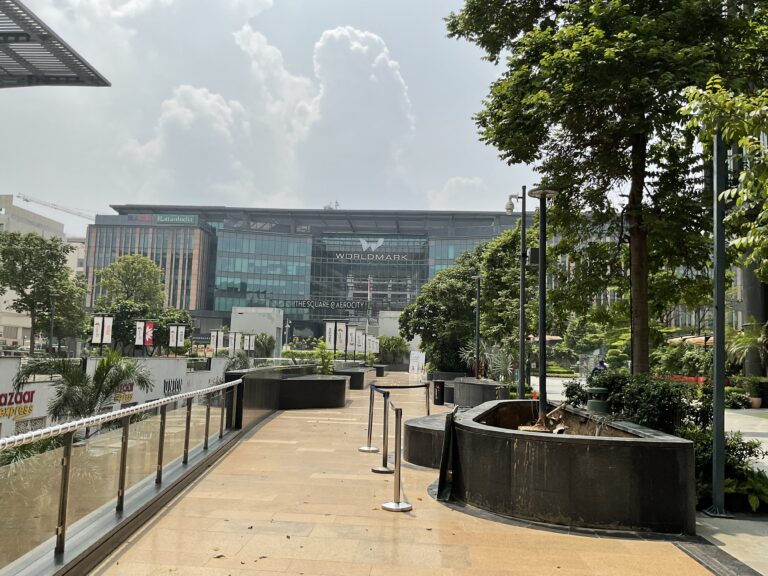
The most transformative developments came in two distinct areas: Moti Nagar and Dwarka. Moti Nagar, traditionally an industrial area, has seen significant modernization with developments like the DLF Tower, which introduced contemporary office standards to the region. Meanwhile, Dwarka, planned as a sub-city, emerged in the late 1990s and early 2000s as a modern commercial destination. Modern developments like D21 and Vegas Tower in Dwarka have set new standards for office space in West Delhi, offering contemporary amenities and efficient floor plates. These developments, along with the Delhi State Industrial and Infrastructure Development Corporation (DSIIDC) Square and the Sector 13 commercial complex, represent the new face of West Delhi’s commercial real estate.
Current Market Dynamics
West Delhi’s commercial real estate market presents a diverse range of options, with rentals varying significantly based on location and building quality. Dwarka commands the highest rentals in the region, with Grade A spaces in sectors 13 and 14 ranging from ₹80-120 per square foot. The District Centre developments typically achieve rentals between ₹60-90 per square foot.
The traditional commercial areas show more modest rates: Janakpuri District Centre commands ₹50-70 per square foot for comparable spaces, while Rajouri Garden ranges from ₹45-65 per square foot. Naraina and Moti Nagar, with their industrial heritage, see rates between ₹40-60 per square foot for office spaces.
The commercial building stock in West Delhi varies considerably in age and quality. The older industrial-era buildings, particularly in Naraina and Mayapuri, often struggle with basic infrastructure and parking challenges. Many of these structures, originally designed for industrial use, have been minimally modified for office use, resulting in compromised functionality.
Notable Commercial Properties and Their Current State
West Delhi’s commercial landscape presents a stark contrast between its modern developments and older commercial stock. The DLF Tower in Moti Nagar represents one of the area’s premier modern office developments, introducing contemporary standards and amenities to this traditionally industrial area. In Dwarka, developments like D21 and Vegas Tower showcase the new face of West Delhi’s commercial real estate, offering modern specifications, efficient floor plates, and contemporary workplace amenities.
In contrast, the District Centre developments present a more varied picture. Janakpuri District Centre’s commercial buildings, including Mahatta Tower, Sagar Tower, Vishal Tower, Jyoti Shikhar, Suneja Tower, and Vishwadeep Tower, while strategically located, show their age through dated infrastructure and limited modern amenities. These buildings, developed in the 1980s, need substantial modernization to meet contemporary office requirements.
The Rajouri Garden District Centre, despite its strategic location and ambitious plans, remains partially developed with only 5 of the planned 11 commercial buildings completed. The unrealized iconic building project, intended to rival the India Habitat Centre, reflects the development challenges faced in this area.
Infrastructure and Connectivity
West Delhi’s commercial areas benefit from excellent metro connectivity through the Blue and Green Lines, significantly enhancing their accessibility. Major arterial roads including Najafgarh Road, Patel Road, and the Ring Road provide vehicular connectivity, though traffic congestion remains a challenge.
The region faces significant infrastructure challenges, particularly in older commercial areas. Parking remains a critical issue in most locations except Dwarka, where planned development has incorporated adequate parking facilities. Power infrastructure varies significantly, with newer developments offering reliable supply while older areas often require significant backup systems.
Impact of Master Plan Delhi 2041
MPD 2041 introduces several provisions that could significantly impact West Delhi’s commercial landscape:
The plan allows for the redevelopment of industrial areas with enhanced FAR, particularly benefiting areas like Naraina and Mayapuri where many buildings require comprehensive upgrading. Transit-oriented development provisions along metro corridors create opportunities for new commercial developments, especially in Dwarka and along the metro lines.
Mixed-use development norms offer potential for modernizing older commercial buildings while introducing new uses. This is particularly relevant for areas like Moti Nagar and Rajouri Garden, where aging commercial stock could be redeveloped into modern mixed-use projects.
Future Outlook
West Delhi’s commercial real estate market shows significant potential for transformation under MPD 2041. The region’s excellent connectivity, relatively affordable rates, and large land parcels suitable for redevelopment present opportunities for creating modern office spaces.
The market is witnessing several emerging trends: Dwarka continues to attract new commercial developments, setting higher standards for office spaces in West Delhi. The redevelopment of industrial areas under new policies could create significant new office stock, particularly in locations with metro connectivity.
Investment Considerations
West Delhi’s commercial real estate market presents unique investment opportunities, particularly in areas marked for redevelopment. The relatively lower entry costs compared to Central and South Delhi, combined with strong connectivity and potential for value appreciation under MPD 2041, make it an attractive proposition for investors willing to navigate the transformation of older properties.
However, investors must consider several challenges: Many older properties require substantial capital investment for upgrading to modern standards. The mixed industrial-commercial character of some areas may limit their appeal to certain tenant segments. Parking remains a critical challenge in most locations except Dwarka.
Looking ahead, West Delhi’s commercial real estate market appears poised for significant transformation. The implementation of MPD 2041, combined with infrastructure improvements and the redevelopment of older properties, could reshape the region’s commercial landscape. The success of Dwarka’s commercial developments demonstrates the potential for modern office spaces in West Delhi, while the planned redevelopment of industrial areas could create new opportunities for commercial real estate development.